Puritanism was a religious movement which had emerged in Christianity against Roman Catholicism in 16th and 17th century. It was founded by some of the returning clergy exiled under Mary I shortly after the accession of Elizabeth I of England in 1558 as an activist movement within the Church of England. Puritans had changed the Britain and cultivate the America by their strong belief, hardworking and disciplined practices.
Puritanism rise from within Protestantism which was severely suppressed by Mary I between 1553 and 1558. Mary was an only child of Henry VIII and Catherine of Aragon to survive to adulthood. Though, her father was the founder of Anglican Church, her mother was Catholic and she was well educated as a Catholic. As a result, many Protestant and Anglican clergy and people were executed and forced to immigrate. They chose to immigrate Netherlands where Calvinism was rising.
In 1558, Elizabeth I throned who was the daughter of Henry VIII and Anne Boleyn. She was Anglican and had continued to reform Anglican Church which was begun with his father. Many immigrated Protestants and Anglicans had returned to England. It was the rise of Puritan movement during the reign of Elizabeth I from 1558 to 1603.
What was Puritanism and what was the aim of Puritans?
First of all, they did not want to established separate church as did Calvinists or Separatists. They had wanted to reform English Reformed Church which had still used Roman Catholic Practices. While the appointment of clergy was under the authority of Pope in Roman Catholicism, it was likewise under the authority of King in England. They had argued the right of select their own clergy, not appointed by one divine or something else authority. Moreover they had wanted to refuse or at least reform The Book of Common Prayer. There were many reformations in Puritan churches, removing of altars and sculptures were few of them. As a summary, Puritans aim was to purify English Reformed Church.
After the death of Elizabeth I, James I tried to reconcile Puritans in England however it was not possible. And day by day the pressure on Puritans had begun to grow. It was the time to immigrate again especially for Separatists.
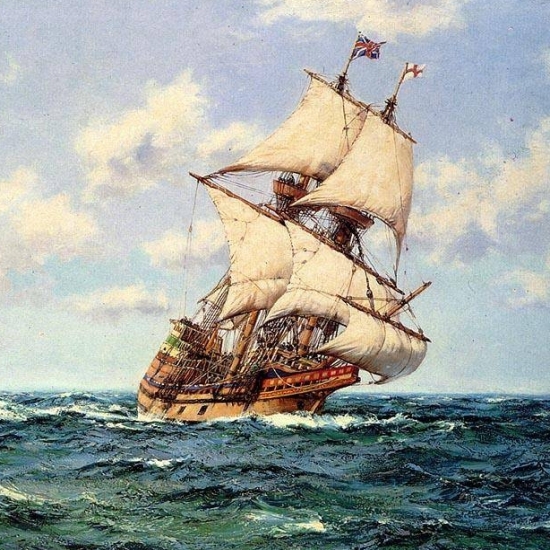
In 1620, the first group of Separatists sailed from England by the legendary Mayflower ship to New England. There were 102 passengers most of them Puritan Separatists. There were families among the passengers. The passengers mostly slept and lived in the low-ceilinged great cabins. These cabins were thin-walled and extremely cramped. The cabin area was 25 feet by 15 at its largest, and on the main deck, which was 75 by 20 at the most. Below decks, any person over five feet tall would be unable to stand up straight. The maximum possible space for each person would have been slightly less than the size of a standard single bed. The Mayflower passengers were the earliest permanent European settlers in New England, referring to themselves as "First Comers". They lived in the perilous times of what was called "The Ancient Beginnings" of the New World adventure.
At the end of 66 days journey, they reached Massachusetts (on the tip of Cape Cod at what is now Provincetown) in 21 November 1620.
Upon arrival late in the year, the harsh climate and scarcity of fresh food caused many more deaths. Due to the delay in departure, provisions were short. Living in these extremely close and crowded quarters, several passengers experienced scurvy, a disease caused by a lack of the essential nutrient vitamin C. There was no way to store fruits or vegetables without their becoming rotten, so many passengers did not receive enough nutrients in their diets. Passengers with scurvy experienced symptoms such as rotten teeth, which would fall out; bleeding gums, and stinking breath.
In 1621, half of them were already died. Winter was coming and if they could not find food, rest of them would die.
Wampanoag (people of dawn) people were Native Americans who had been lived in the region of Massachusetts more than 10.000 years. They met with European colonists before, among them there were one who travelled to Europe before as an interpreter, and his name was Tisquantum (Squanto). Squanto met with passengers of Mayflower in 1621 and he taught them how to plant crop, to fish and hunt beaver.
In the fall of 1621, the Pilgrims famously shared a harvest feast with the Pokanokets; the meal is now considered the basis for the Thanksgiving holiday. They had survived at the end and it was the time to cultivate their land.
According to their religious belief, man born with original sin and any attempt or any behaviour cannot be reason to forgiveness. The only salvation can be granted by God as grace of God. This grace is a result of only goodness of God not our behaviours. They did not believe the ritual of Confession, which according to them let people to make mistakes, so they lived disciplined life in order to achieve God's Kingdom in the world. Such a discipline let them survived in this harsh climate.
Education was important part of their life. Bible was sent to them and every Puritan should read it, so especially reading ability was indispensible for them.
In the end of 1640, they proved that they could survive and build a colony in New England. More than 20.000 thousands of Puritans, Separatists followed them until reconvention of parliament in 1640. After 1640 many Puritans chose to stay in England and attended to rebel move which would be end with the execution of Charles I and imprison of the archbishop of Charles I, William Laud.
Today 35 million people of USA claim an ancestral lineage with these 102 passengers. That number represents 12 per cent of the American population.