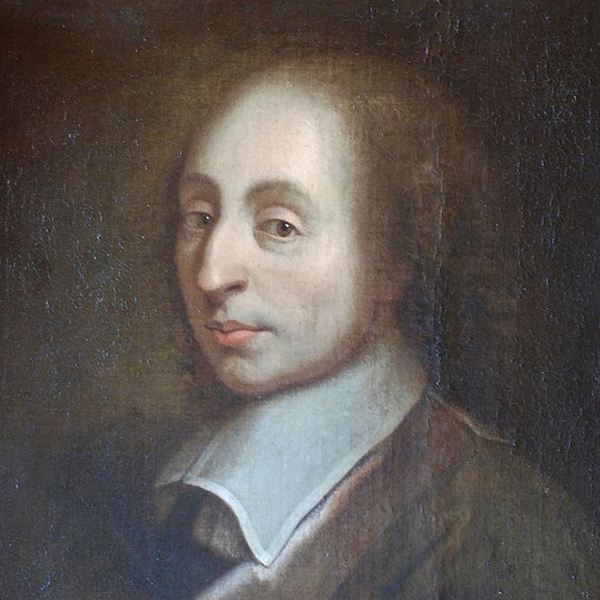
He was lucky to born after Copernic, since he could be curious about the importance of human through infinite universe, at the same time he was unlucky to born before Darwin, since he could not consider the age of earth more than 6000 years. How would it be if Blaise Pascal born in 21st century. Despite his relatively short life and limited scientific knowledge of his era, he left us several theorems which are the first steps of modern economics, social science and hydrostatic, and ideas which are still useful for human happiness, enjoyment and epistemology.
As if he had known he would had short life, he had started to study and published his first essay on conics in 1939 when he was 16 years old. Which was convinced as his father's essay by Descartes. His father who had decided to educate his 3 children by himself after his wife death, was local judge and also interested in mathematics too.
In 1642, before his 20s, he invented first calculator (Pascal calculator - Pascaline) in the history to aid his father in his calculations.
But his legacy began with his study in hydrostatic. Before Pascal, every scientist had been educated by Aristotle science which argues that universe is formed by visible and invisible substances and all of these substances are moving with effect of the other whether visible or invisible. Pascal studied on hydrostatics, especially on Toricelli's papers, first he discovered that it is not the weight of liquid; it is the height of liquid which determines the pressure of liquid with his famous experiment. He put a thin glass tube with height equal to third floor of building, into a barrel and pours water in it. He saw that water was leaking from barrel. And then he repeated his experiment with mercury. He put the glass tube with full of mercury upside down in a bowl of mercury and he observed that at the top of the glass there was a vacuum. His experiment and conclusions were shocking, he claimed that there was not any invisible matter there was only nothing (vacuum). Pascal gave one of the 17th century's major statements on the scientific method, which is a striking anticipation of the idea popularised by Karl Popper that scientific theories are characterised by their falsifiability: "In order to show that a hypothesis is evident, it does not suffice that all the phenomena follow from it; instead, if it leads to something contrary to a single one of the phenomena, that suffices to establish its falsity." His insistence on the existence of the vacuum also led to conflict with other prominent scientists, including Descartes.
The name pascal was adopted for the SI unit newton per square metre (N/m2) by the 14th General Conference on Weights and Measures in 1971.
Although Gerolamo Cardano one of the greatest mathematician of the Renaissance era, was the first mathematician who tried to analyse games of chance, Blaise Pascal was considered as a rhetorician of probability theory with his friend Pierre de Fermat. They theorized probability while they were trying to find an answer of one gambler's famous question.
If we would finish the game early, how should we share the amount of bet fair.”
While The Notion of expected value had been firstly introduced, Risk calculation had been firstly attempted in their studies. Beyond of this question they had studied to find the answer of one of the most asked question in history.
What will be? What is waiting us in the future? Can future be predictable?“
Christiaan Huygens published a book on the probability theory with information gathered by Pascal and Fermat in 1657 and in the 19th century a big work was done by Laplace in what can be considered today as the classic interpretation.
In 1946 his father broke his lip and during his father's treatment he and his sister was influenced by his father's doctors who were household guests and fellows of Jansenism and he began to write theological subjects which would be published after his death in the name of Pensees.
Pascal was the first man in the World who had tried to explain theological questions and subjects by probability and he claimed existence of God as a gambler with probability.
Imaginary, the formula of Happiness (diversion and enjoyment), epistemology (heart and empiricism), the past, the present and the future notions are the other revolutionary ideas of Pascal in Pensees.